Olde Town Arvada Buyer’s Guide And Neighborhood Overview
Thinking about buying in Olde Town Arvada? It is easy to see the appeal. You get a historic downtown feel, rail access, local shops and restaurants, and a neighborhood identity that feels distinct from many newer suburban areas. If you are trying to decide whether Olde Town is the right fit, this guide will help you understand the housing, lifestyle, market conditions, and special rules that can shape your purchase. Let’s dive in.
Olde Town Arvada is the historic downtown core of Arvada, centered in the city’s original townsite. Arvada’s formal town notice dates to December 1, 1870, and that long history still shapes the area today.
What makes Olde Town stand out is that it is not preserved as a frozen-in-time district. The city and local district organizations describe it as a historic center that continues to evolve, with reinvestment and new development designed to fit the existing urban fabric.
For you as a buyer, that means Olde Town offers a mix of character and change. You can enjoy the feel of an older Colorado main street while still benefiting from newer housing options, updated public spaces, and transit connections.
The historic district reflects Arvada’s earliest growth patterns. National Register documentation describes it as a concentrated collection of commercial, residential, social, religious, and industrial buildings shaped by corridors like Grandview Avenue, Wadsworth Boulevard, and the railroad.
Today, the area is known for its turn-of-the-century Main Street ambiance. The Olde Town Arvada BID describes a district filled with shops, galleries, restaurants, breweries, and a winery, which gives the neighborhood a lively but still local feel.
If you are comparing neighborhoods, Olde Town often appeals to buyers who want a walkable district with a strong sense of place. It can feel more urban than a typical suburb, but without placing you in central Denver.
One of the biggest misconceptions about Olde Town is that it is all one housing type. In reality, the district includes a wide range of buildings, from single-family homes to retail, office, and mixed-use properties.
The city’s Olde Town zoning districts allow several residential forms. Depending on the exact area, permitted housing types can include single-family detached homes, duplexes, multiplexes, boarding or lodging houses, live-work units, townhomes, apartments, multifamily housing, and mixed-use buildings.
That variety matters because it gives you more than one way to enter the neighborhood. Some buyers may focus on older detached homes with historic charm, while others may prefer lower-maintenance townhomes, condos, or newer infill close to the district.
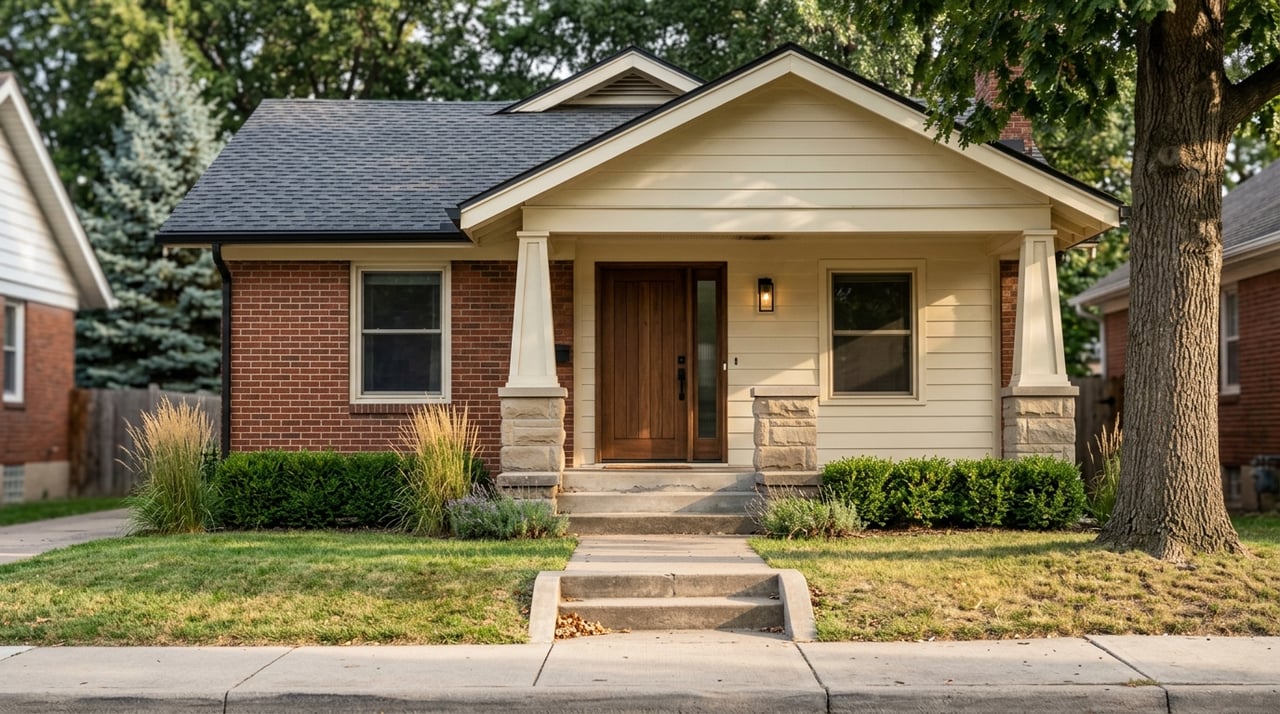
If you are drawn to older architecture, the broader historic fabric around Olde Town offers useful context. Nearby historic areas include Reno Park, where the city says most single-family homes were built in the 1800s, and Stocke-Walter, where National Register documentation notes home styles such as Classic Cottage, Bungalow, Queen Anne, and vernacular homes built from 1893 through 1947.
In practical terms, that means buyers looking in and around Olde Town may encounter early homes with details that are hard to replicate in newer construction. You may also find homes that need updates, and those updates can come with extra planning if the property falls under historic review.
This is one of the most important parts of buying in Olde Town. The city states that any modification, addition, restoration, or redevelopment in the historic district or Olde Town zoning area must obtain a Certificate of Compliance with the Olde Town Design Guidelines before construction.
If you are considering a historic home, do not assume you can make exterior changes on your own timeline. Renovation plans, additions, and major visible updates may require preservation review, which can affect both budget and timing.
That does not mean buying here is difficult. It simply means you should go in with a clear understanding of the process so you can evaluate a home not just for how it looks today, but for what will be involved if you want to change it later.
These questions can help you avoid surprises and choose a property that matches both your lifestyle and your long-term plans.
Olde Town’s transit access is one of its biggest practical advantages. RTD says the G Line is an 11.2-mile electric commuter rail line connecting Denver Union Station to Wheat Ridge, with seven stations including Olde Town Arvada.
The Olde Town Arvada Station is also identified by RTD as a rail station park-and-ride with paid parking. The city notes that Olde Town is one of three Arvada stops on the G Line connecting residents and visitors to the metro region and Denver International Airport.
For many buyers, this can be a major lifestyle upgrade. You get a neighborhood with local character and walkability, but you still have a direct regional transit connection that can support commuting, airport access, and outings into Denver.
Lifestyle is a major reason people buy here. The BID highlights Olde Town’s mix of shops, boutiques, galleries, events, restaurants, breweries, and a winery, while the city points to an abundance of locally owned shops, restaurants, and bars.
That concentration of local business gives the district a more complete day-to-day experience than many suburban shopping areas. You are not just near a few conveniences. You are buying into a place where people gather, walk, dine, and spend time.
Cultural access adds another layer. The City of Arvada says the Arvada Center for the Arts and Humanities offers theater, music, art exhibitions, a history museum, and classes, and the Center provides free admission to its galleries.
For buyers who care about more than square footage, this is an important part of the value story. Olde Town feels like a destination in its own right, not simply a residential area with a train stop.
Olde Town is still evolving, and that matters when you are choosing where to live. The city’s 2023 Olde Town Strategic Reinvestment Plan aims to preserve historic character while improving walkability.
The 2026 Yukon Streetscape project is expected to widen sidewalks, improve crossings, and add pedestrian-friendly features. At the same time, the city notes current street closures and utility work in Olde Town, so some near-term construction impacts are part of the current environment.
For you, this is a tradeoff worth weighing honestly. Ongoing public investment can support long-term neighborhood appeal, but short-term access and construction activity may affect your day-to-day experience depending on where you buy.
Recent market data suggests demand remains steady, though not overheated. Redfin reports that over the three months ending May 2026, Historic Olde Town had a median sale price of $499,832, a median sale price per square foot of $402, average days on market of 35, and a sale-to-list ratio of 98.8%.
Realtor.com shows a similar general picture, though with different timing and methodology. Its neighborhood page lists a median listing price of $510K, 13 active homes, and an average of 58 days on market.
Taken together, these figures point to a market with limited inventory and some price sensitivity. Homes are still moving, but buyers may have a bit more room to evaluate condition, location, and value than they would in a more frenzied market.
This is especially important in Olde Town because housing here does not trade like a uniform subdivision. Historic homes, infill properties, and mixed-use-adjacent residences can each attract different buyers and show value in different ways.
For buyers who are also looking at close-in Denver neighborhoods, Olde Town can offer a meaningful price difference. Realtor.com’s nearby neighborhood comparisons place Berkeley at $837,500 and West Highland at $849,000, while Northwest Arvada is listed at $637,000.
That does not make Olde Town inexpensive in every case, especially for updated or especially well-located homes. Still, it helps position the neighborhood as a lower-price alternative to some Denver main-street areas while still offering rail access and a historic downtown setting.
If your goal is to balance lifestyle, location, and budget, that comparison is worth paying attention to. You may find that Olde Town delivers many of the qualities you want at a lower entry point than some closer-in Denver options.
Olde Town tends to be a strong fit if you value historic character, a walkable district, and access to local businesses and transit. It can also be a smart choice if you appreciate neighborhoods with a clear identity and are comfortable living in an area that is still seeing reinvestment and public improvements.
It may be less ideal if you want a highly uniform housing stock, minimal renovation considerations, or a setting with no nearby construction or planning activity. The right fit often comes down to how much you value charm, convenience, and place-making compared with simplicity.
If you want help comparing Olde Town Arvada to other Denver-area neighborhoods, or you are ready to start your search, Lisa Taylor can help you evaluate options with a local, strategic perspective.

Stay up to date on the latest real estate trends.


Her tireless work ethic, knowledgeable market insight, and understanding of customer expectations leave a lasting impression with clients and colleagues and contribute to her outstanding sales and marketing track record.