Denver Country Club
It's one of the city's most historic and prestigious neighborhoods, characterized by its classic architecture and lush landscapes.
It's one of the city's most historic and prestigious neighborhoods, characterized by its classic architecture and lush landscapes.
The Denver Country Club neighborhood is one of the most architecturally significant and historically protected residential enclaves in the American West. Comprising approximately 380 homes developed primarily between 1902 and 1945, this National Register Historic District unfolds along winding curved streets with no alleys or sidewalks — an intentional design that gives the neighborhood its distinctive English countryside character in the heart of central Denver. Colonial Revival, Mediterranean, Tudor, and Georgian estates designed by legends of Denver architecture, including Fisher & Fisher, Burnham Hoyt, and Temple Hoyne Buell, line streets that have changed remarkably little in a century. With a median sale price ranging from $1.7 million to $2.6 million and recent transactions reaching $8.6 million, Denver Country Club is unambiguously Denver's most prestigious historic residential address. Whether you are searching for homes for sale in Denver Country Club as a primary residence or a generational estate, this guide gives you everything you need to understand this irreplaceable community.
Lisa Taylor is a Denver native who has specialized in Denver Country Club and the city's finest luxury neighborhoods since 1992. Recognized as a Top 1% REALTOR® nationally and ranked #2 Individual Agent at Compass Denver, Lisa's depth of knowledge within this specific community — its architectural heritage, street-by-street value differentials, and the off-market relationships that define transactions here — is unmatched in the Denver real estate market.
| Denver Country Club Quick Facts | Detail |
|---|---|
| Location | Denver, CO — south of First Avenue, between University and Race/Humboldt |
| Total Homes | ~380 residences (one of Denver's most intimate neighborhoods) |
| Historic Designation | National Register of Historic Places (1979); Denver Landmark District (1990) |
| Development Period | 1902–1945 (primary); some newer renovations and additions |
| Median Sale Price | ~$1.7M–$2.6M (2025–2026, up 9–17% YoY) |
| Notable Sale (2026) | 181 Race Street — $8,595,000 cash in 9 days (6 BD / 9 BA) |
| Avg. Days on Market | ~69 days (down from 113 days prior year; well-priced homes sell much faster) |
| Key Architects | Fisher & Fisher, Burnham Hoyt, Temple Hoyne Buell, Jules Jacques Benoit Benedict |
| School District | Denver Public Schools — Denver East High School |
The Community
The Denver Country Club neighborhood is one of the few residential districts in the American West where walking the streets feels genuinely different from any other place in the city. The absence of alleys and sidewalks — an intentional planning decision from the neighborhood's earliest development — means that expansive front lawns flow uninterrupted to the curving streets, mature elms and lindens form a canopy over the roadway, and the overall character of the neighborhood resembles, as residents and visitors have long noted, an English country estate community transplanted to the heart of Denver. With only approximately 380 homes in the entire district, most built between 1902 and 1945, Denver Country Club is as intimate as it is architecturally distinguished.
National Historic Landmark
The western portion of the neighborhood was listed in the National Register of Historic Places in 1979. In 1990, the full Country Club Historic District was designated as a Denver Landmark District, protecting the architectural character and scale of the neighborhood's approximately 380 residences in perpetuity. This designation is one of the most meaningful quality protections available to any residential community in Colorado.
No Alleys. No Sidewalks.
The Country Club neighborhood's planning deliberately omitted alleys and sidewalks to preserve the expansive, uninterrupted lawn character that distinguishes it from all other Denver neighborhoods. Cars are accessed from the street via private drives, and the absence of sidewalks means residents walk on the street or across lawns — a design that contributes directly to the neighborhood's quiet, estate-like atmosphere.
The Denver Country Club
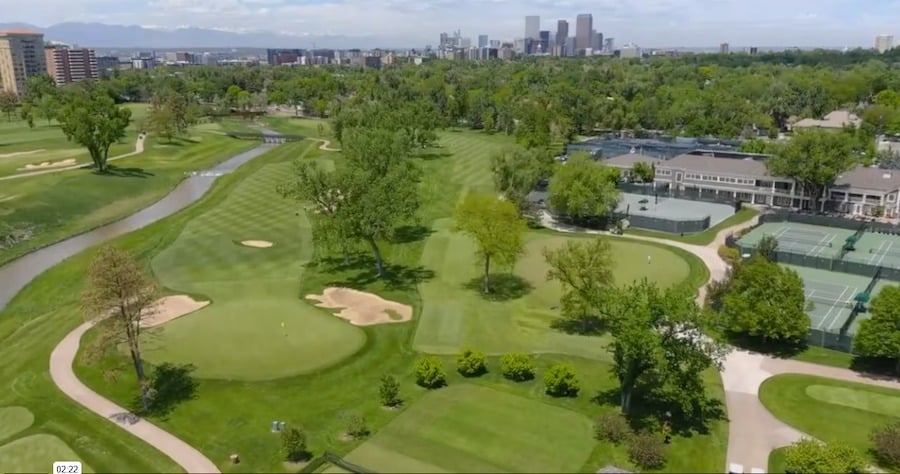
The Denver Country Club itself — the private institution from which the neighborhood takes its name — was founded in 1887 and relocated to its current site as the neighborhood was being developed. Members enjoy golf on one of Denver's most historically significant private courses, tennis, fine dining, and a full social calendar. Proximity and in many cases membership access to the Club is a defining feature of life in the neighborhood.
Extraordinary Scarcity
With only ~380 homes in the entire neighborhood and the landmark designation preventing new construction that would alter the district's character, Denver Country Club real estate is among the most supply-constrained markets in all of Colorado. Typically fewer than 10 to 15 properties are available at any given time. When a Country Club estate comes to market, it is an event in Denver's luxury real estate calendar.
Architecture
The Country Club Historic District is widely considered the finest collection of early 20th-century residential architecture in Colorado. Development began in 1905 with Park Club Place, followed by Country Club Place in 1906, the Country Club Annex in 1924, and Park Lane Square in 1926. The neighborhood's 380 residences represent virtually every prestigious architectural style of the era: Colonial Revival, Mediterranean, Tudor, Georgian, and the distinctively Denver vernacular of the Denver Square.
The architects who designed these homes represent the pantheon of Denver's architectural history. Fisher & Fisher — brothers William and Arthur Fisher — were responsible for some of the neighborhood's most celebrated Mediterranean Revival designs, inspired by Arthur's voyages through Southern Europe. Burnham Hoyt, Temple Hoyne Buell, and Jules Jacques Benoit Benedict each contributed significant works that remain among the most architecturally distinguished residences in the state. Maurice B. Biscoe's Mediterranean stucco residence at 320 Humboldt Street is one of the neighborhood's most frequently cited examples of the form.
The Denver Landmark District designation, adopted in 1990, establishes a Design Review process for changes to exterior elements of contributing properties, ensuring that renovations and additions respect the architectural character that makes the neighborhood irreplaceable. For buyers considering renovation, understanding this process is essential — and Lisa Taylor guides every Country Club buyer through the landmarks review implications before any purchase decision is made.
Market
The Denver Country Club real estate market is among the most dynamic and tightly supply-constrained markets in Colorado. The median sale price has ranged from $1.7 million to $2.6 million in 2025-2026, representing a 9% to 17% year-over-year increase that reflects both sustained demand from high-net-worth buyers and the extraordinary scarcity of available properties. Homes are selling in approximately 69 days on average — down significantly from 113 days the prior year — with well-priced, well-positioned properties moving much faster.
The most notable recent transaction — 181 Race Street, a six-bedroom, nine-bath estate that sold for $8,595,000 in just nine days to a cash buyer — underscores the appetite among Denver's top luxury buyers for the neighborhood's finest properties. This sale represents the ceiling of what the Country Club market has achieved in recent cycles and suggests continued strength at the upper tier as qualified buyers remain very few options of this caliber anywhere in the city.
The neighborhood's permanent supply constraint — approximately 380 total homes, protected from new development by Landmark designation — is a structural advantage that has supported values through every Denver market cycle for over a century. Buyers who acquire a Denver Country Club property are not simply purchasing a home; they are acquiring a position within one of the most protected and limited residential markets in the entire western United States.
| Metric | Denver Country Club | Cherry Creek (Neighborhood) |
|---|---|---|
| Median Sale Price | ~$1.7M–$2.6M | ~$1.2M–$1.6M |
| YoY Price Change | +9%–+17% | +3%–+6% |
| Total Homes | ~380 (fixed, Landmark protected) | ~1,500+ |
| Avg. Days on Market | ~69 days (well-priced: much faster) | ~23–36 days |
Lifestyle
The Country Club neighborhood offers a lifestyle that is genuinely unlike any other in Denver: the privacy and quiet of an estate community in the heart of a major city, within walking distance of Cherry Creek North's luxury shopping and dining, minutes from downtown and the Denver Art Museum, and adjacent to Cheesman Park's 80-acre urban oasis. Residents describe the neighborhood as a place where the pace changes the moment you turn off First Avenue onto Country Club's winding, tree-canopied streets.
Denver Country Club Access
The Denver Country Club, founded in 1887, is one of Colorado's most historically significant private institutions. Members enjoy golf on a meticulously maintained private course, tennis facilities, a fully appointed clubhouse with fine dining, and a calendar of member events that is among the most active in the Denver social scene. Many Country Club neighborhood residents hold club membership, and the Club's presence defines the social fabric of the surrounding community.
Cherry Creek North — Walking Distance
Cherry Creek North's 16-block pedestrian shopping and dining district is a 5 to 10-minute walk from most Country Club addresses. Louis Vuitton, Tiffany & Co., Neiman Marcus, and Cherry Creek Shopping Center are similarly accessible, giving Country Club residents immediate walking access to the finest retail and restaurant corridor in the Rocky Mountain region.
Cheesman Park and the Botanic Gardens
Cheesman Park, an 80-acre urban park just northeast of the neighborhood, offers broad lawns, a classical pavilion, tennis courts, and views of the Front Range. The Denver Botanic Gardens, one of the top botanical institutions in the country, is minutes away in Congress Park, hosting summer concerts, world-class horticultural exhibitions, and community events throughout the year.
Cherry Creek Trail
The Cherry Creek Trail, Denver's most celebrated multi-use path, is accessible within minutes of Country Club, connecting residents by bike to downtown Denver, Washington Park, and the broader trail network that extends south toward Chatfield Reservoir. Country Club's central location makes it an ideal base for residents who want car-free access to much of the city's most active corridors.
Location
The Country Club neighborhood is bounded by First Avenue to the north, University Boulevard to the west, Fourth Avenue to the south, and Race and Humboldt Streets to the east. This positioning places the neighborhood directly between the Cherry Creek district to the north, Washington Park to the south, Congress Park to the east, and Speer Boulevard's connection to downtown to the northwest. The neighborhood is among the most centrally located residential districts in Denver — equidistant between Cherry Creek shopping, downtown's Union Station, the Denver Art Museum complex, and the Cherry Creek Trail.
Cherry Creek North
5–10 min walk
Downtown Denver
~10 min by car or bike
Denver Tech Center
~20–25 min via I-25
DIA Airport
~30–40 min via I-70
Education
The Country Club neighborhood is served by Denver Public Schools (DPS). The attendance high school for Country Club is Denver East High School, one of the district's most respected comprehensive public high schools with strong AP programming, competitive athletics, and a long history as a cornerstone of central Denver's educational community. East High's campus, adjacent to City Park, the Denver Museum of Nature and Science, and the Denver Zoo, gives students a setting that is genuinely distinctive.
DPS also operates a school choice model allowing families to apply to specialized programs including the Denver School of the Arts, DSST Public Schools, and multiple magnet and focus school options district-wide. Private school options within close proximity include Graland Country Day School (one of Denver's most prestigious K-8 independent schools, located directly adjacent to the neighborhood), Kent Denver School, and several faith-based institutions accessible within 10 to 20 minutes.

Every Detail. Every Home.
Lisa Taylor has specialized in the Denver Country Club neighborhood since the early years of her career, which began in Denver in 1992. In a neighborhood of only 380 homes where annual transaction volume rarely exceeds 15 to 20 sales, the agent you choose must have specific community knowledge — understanding which streets and lots carry the strongest long-term premiums, which properties are priced appropriately relative to their condition and renovation history, and which off-market opportunities may exist among homeowners who are considering but have not yet listed. Lisa has those relationships.
Ranked #2 Individual Agent at Compass Denver and recognized nationally as a Top 1% REALTOR®, Lisa's 25+ years of Country Club and South Denver luxury expertise makes her the most experienced advisor available in this market. If Denver Country Club is your target, your search begins with Lisa Taylor.
Let's ConnectThe median sale price in the Denver Country Club neighborhood has ranged from $1.7 million to $2.6 million in 2025-2026, representing a 9% to 17% year-over-year increase. The most significant recent transaction — 181 Race Street — closed at $8,595,000 in 9 days. Properties in this neighborhood span from approximately $1.5 million for smaller or less updated homes to $9 million and above for the finest estates.
The absence of alleys and sidewalks was a deliberate planning decision by the neighborhood's early 20th-century developers, who sought to create a residential environment that felt more like an English estate community than a conventional Denver neighborhood grid. The result — expansive, uninterrupted front lawns flowing to the curbing of curved streets — is one of the neighborhood's most distinctive physical characteristics and contributes directly to its quiet, estate-like atmosphere.
The Denver Landmark District designation, adopted in 1990, means that exterior changes to contributing properties require review by the Denver Landmark Preservation Commission. This protects the architectural character that makes the neighborhood irreplaceable, but also means buyers considering major renovations or additions must understand the Design Review process before purchasing. Lisa Taylor advises every Country Club buyer on Landmark implications specific to any property under consideration.
Cherry Creek North's pedestrian shopping and dining district is 5 to 10 minutes on foot from most Denver Country Club addresses. The Cherry Creek Shopping Center is similarly accessible. This walkable proximity to Denver's finest retail and restaurant corridor — combined with the neighborhood's quiet residential character — is one of Country Club's most compelling lifestyle advantages.
Lisa Taylor has specialized in the Denver Country Club neighborhood since 1992 as a Denver native with over 25 years of direct community experience. In a neighborhood of only 380 homes where annual transactions rarely exceed 15 to 20 properties, specific community knowledge — understanding which streets and positions command premiums, which properties have renovation upside, and which homeowners may be considering an unlisted sale — is the critical differentiator. Lisa maintains the relationships and track record within Country Club that no generalist agent can replicate.
Lisa Taylor is ready to guide you through every property and opportunity in the Denver Country Club neighborhood. Browse current listings or connect with Lisa directly for a confidential consultation and off-market intelligence.
3,306 people live in Denver Country Club, where the median age is 50 and the average individual income is $176,657. Data provided by the U.S. Census Bureau.
Total Population
Median Age
Population Density Population Density This is the number of people per square mile in a neighborhood.
Average individual Income
There's plenty to do around Denver Country Club, including shopping, dining, nightlife, parks, and more. Data provided by Walk Score and Yelp.
Explore popular things to do in the area, including Salon Sherwood.
Denver Country Club has 1,407 households, with an average household size of 2. Data provided by the U.S. Census Bureau. Here’s what the people living in Denver Country Club do for work — and how long it takes them to get there. Data provided by the U.S. Census Bureau. 3,306 people call Denver Country Club home. The population density is 5,256 and the largest age group is Data provided by the U.S. Census Bureau.
Total Population
Population Density Population Density This is the number of people per square mile in a neighborhood.
Median Age
Men vs Women
Population by Age Group
0-9 Years
10-17 Years
18-24 Years
25-64 Years
65-74 Years
75+ Years
Education Level
Total Households
Average Household Size
Average individual Income
Households with Children
With Children:
Without Children:
Marital Status
Blue vs White Collar Workers
Blue Collar:
White Collar:
Her tireless work ethic, knowledgeable market insight, and understanding of customer expectations leave a lasting impression with clients and colleagues and contribute to her outstanding sales and marketing track record.